Gut Health and Weight Loss: What the Evidence Actually Says
An honest, evidence-led look at how gut health really affects weight — what the food-first habits do, where probiotic supplements actually help, and what the marketing oversells.


The honest answer is more interesting than the wellness aisle suggests. Your gut microbiome does influence appetite, inflammation and how your body handles food — but the interventions that move the needle on both gut health and weight are food-based, not supplement-based. More dietary fibre, a wider variety of plant foods, regular fermented foods, less ultra-processed food, and a decent night's sleep do more for your microbiome and your waistline than any probiotic capsule on the shelf. The supplement story is mostly small-effect, strain-specific, and oversold by the marketing.
This article walks through what the evidence actually says — the mechanisms that are real, the food habits that work, the narrow place where probiotic supplements help, and the claims you can safely ignore. No "fix your gut to fix your weight" promises. Just the levers, in the order they matter.
What gut health actually has to do with weight
Your gut microbiome — the trillions of bacteria, fungi and other microbes living mainly in your large intestine — does interact with weight regulation. There are three credible mechanisms:
Appetite hormones. When your gut microbes ferment dietary fibre, they produce short-chain fatty acids like butyrate, propionate and acetate. These trigger the release of GLP-1 and PYY — the same fullness hormones that some weight-loss drugs mimic. A higher-fibre diet, especially one rich in fermentable fibres like inulin, increases GLP-1 and PYY and reduces hunger ratings in randomised trials.
Energy harvest and inflammation. Different microbial communities extract calories from food slightly differently, and an imbalanced microbiome can drive low-grade inflammation that interferes with insulin signalling. The mechanism is real; the size of the effect in a real diet is small.
Where the marketing gets ahead of the science. You'll see the claim that "obese people have a different ratio of Firmicutes to Bacteroidetes." That finding came from small early studies and has not held up. A 2016 meta-analysis by Sze and Schloss across 10 studies found the F/B ratio was not significantly associated with obesity once you accounted for between-person variation. The microbiome influences weight; it doesn't determine it. Be sceptical of any product that claims to "rebalance your ratio."
The food habits with the strongest evidence
These are the levers that show up over and over in randomised trials and large cohort studies, with effects on both microbiome diversity and weight.
More fibre, especially fermentable fibre. The NHS recommends 30 g of fibre per day, and the average UK adult eats only about 20 g. Closing that 10 g gap is the single highest-leverage move for most people. Lentils, beans, chickpeas, oats, barley, berries, leafy greens and whole grains do the heavy lifting. A bowl of spinach and red lentil curry or a hearty vegetable and lentil soup easily clears 12–15 g of fibre in one meal.
Variety, not just volume. The American Gut Project found that people eating more than 30 different plant foods per week had more diverse gut microbiomes than those eating 10 or fewer — with more of the short-chain-fatty-acid-producing species linked to metabolic health. "Plant foods" includes vegetables, fruits, whole grains, legumes, nuts, seeds, herbs and spices. Aim for variety across the week, not perfection at every meal.
Fermented foods, regularly. A 2021 Stanford study (Sonnenburg lab, Cell) found that adults who ate six servings a day of fermented foods — yogurt, kefir, sauerkraut, kimchi, kombucha — for 10 weeks had increased gut microbiome diversity and lower levels of inflammatory markers. Two or three servings a day is a much more sustainable real-world target. A breakfast of live yogurt with berries and oats, a side of sauerkraut with lunch, or a dinner of miso and tofu noodles gets you there without effort.
Less ultra-processed food. This is one of the most replicated findings in nutrition. The Hall et al. 2019 NIH inpatient trial randomised adults to ultra-processed or unprocessed diets matched for calories, sugar, salt, fat and fibre on the menu — and people on the ultra-processed arm ate about 500 extra calories a day and gained weight. The microbiome story and the calorie story point the same way. You don't need to eliminate convenience foods; just shift the ratio.
Sleep. Short sleep alters appetite hormones and shifts the microbiome within days. It's not glamorous and it doesn't sell capsules, but it's the cheapest intervention on the list.
If you'd rather skip the calculations and see what a personalised plan that hits these targets looks like for your routine and the foods you actually like, start the free 60-second NutriGuide quiz. No app download, no credit card.
Where probiotic supplements actually fit
Short version: a small adjunct, strain-specific, not the headline. The category is genuinely overhyped — we go into the broader supplement marketing claims in our 10 weight-loss supplement myths, debunked with real research piece. What's relevant to gut health and weight specifically:
- The best-supported single trial. Lactobacillus gasseri SBT2055 in fermented milk. The Kadooka 2010 trial in the European Journal of Clinical Nutrition found a 4.6% reduction in abdominal visceral fat over 12 weeks at 200 g/day of fermented milk, in 87 adults with above-average BMI. It's a real result. It is not "lose 10 kg with probiotics."
- Pooled evidence is small and inconsistent. A 2025 meta-analysis in Scientific Reports of 8 RCTs in adults with obesity found probiotic groups lost more weight and visceral fat than controls, with no significant difference in BMI. Effects vary heavily by strain, dose and duration. Most well-controlled trials show under 1 kg of additional weight loss versus placebo — useful as a top-up, not a strategy.
- Strain matters more than "probiotics" as a category. A capsule labelled "weight loss probiotic" with no named strain at a researched dose is mostly marketing.
- Not always benign. Probiotics aren't appropriate for everyone. There are case reports of harm in immunocompromised patients, people with central venous lines, and post-surgical patients. For IBS, IBD, SIBO, post-antibiotic recovery or any chronic condition, the right move is to ask a GP or registered dietitian which strain, if any, is a fit — not to guess in the supplement aisle.
The other supplements often grouped with this category — digestive enzymes, L-glutamine, "leaky gut" formulas — have weak evidence for weight loss in healthy adults. Prebiotics (inulin, FOS) have decent evidence at therapeutic doses (10–16 g/day) but produce significant gas at first, and you can get the same benefit eating onions, garlic, leeks, asparagus, oats and bananas.
A normal day that's good for your gut and your weight
Not a meal plan; a sketch of what the levers look like in practice.
- Breakfast: Blueberry yogurt parfait (live yogurt + plant variety + fibre) or banana almond butter overnight oats (oats are a fermentable-fibre powerhouse).
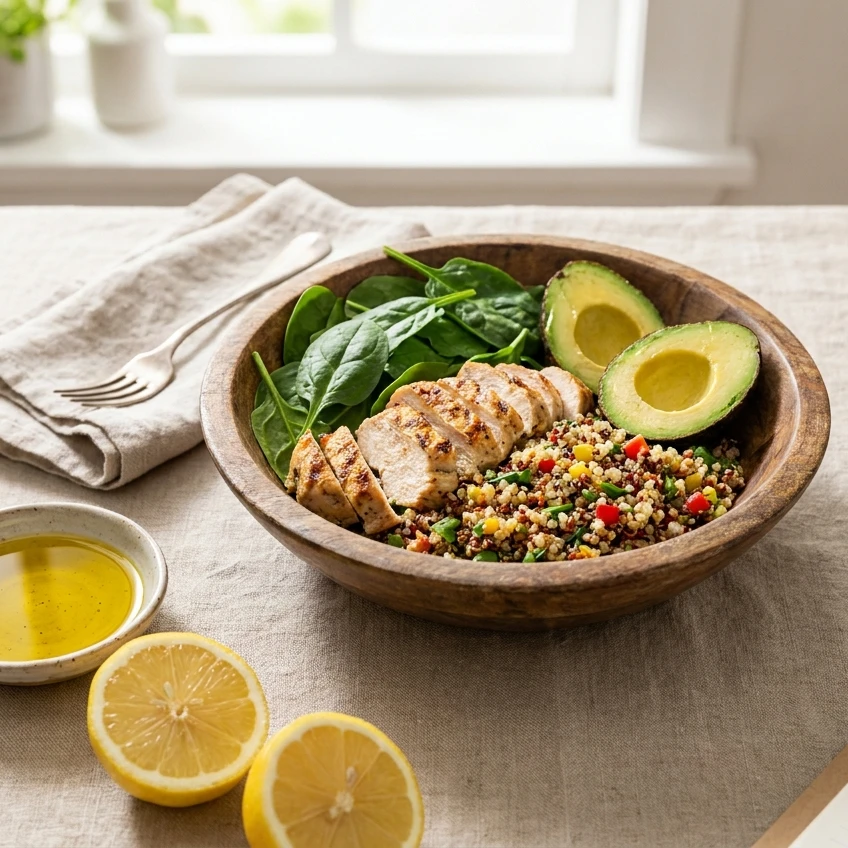
- Lunch: A Mediterranean lentil and quinoa power bowl or hearty vegetable and lentil soup — easily 12–15 g of fibre, several plant types, naturally satiating.
- Snack: A piece of fruit and a small handful of nuts. Different plant types count toward your weekly variety target.
- Dinner: Miso and tofu noodles (fermented + plant protein + variety) or a comfort kimchi jjigae. Add a side of leafy greens or sauerkraut.
- Sleep: lights down 30 minutes earlier than yesterday. Boring. Effective.
Three meals, around 28–30 g of fibre, six or seven different plant types, two servings of fermented food, a normal calorie target. No "gut reset" detox, no expensive capsule. That's the version of "gut health for weight loss" the evidence actually backs.
Want this calibrated to your weight, calorie target and the foods you actually like? Take the free NutriGuide quiz — 60 seconds, no app download, no credit card. You'll get a meal plan that hits the fibre and protein targets, a clear calorie number to aim at, and a short note on whether any supplement is worth your money for your specific case.
This article is general information, not medical advice. Speak to your GP or a registered dietitian before starting probiotic supplements or making significant dietary changes — especially if you are pregnant or breastfeeding, immunocompromised, recovering from surgery, taking regular medication, managing IBS, IBD, SIBO, a thyroid condition or diabetes, or have a history of disordered eating.