How to Balance Macros for Weight Loss: A Beginner's Guide
A plain-English guide to setting protein, fat and carb targets for weight loss — with a worked example you can copy and the food to match it.


The honest version of "balancing macros" is simpler than the fitness internet makes it sound. Macros — short for macronutrients — are the three things in your food that contain calories: protein, fat and carbohydrate. Balancing them for weight loss isn't about chasing a magical 40/30/30 split. It's about setting a calorie target, getting enough protein to keep your muscle while you lose fat, eating enough fat to keep your hormones happy, and letting carbs fill in the rest. Most beginners overcomplicate this. The numbers below are the ones the evidence actually supports, with a worked example you can copy.
This guide is for someone who's heard "track your macros" and isn't sure where to start. We'll cover what each macro does, the gram targets that work for weight loss (not the percentage splits you usually see), how to plug your own numbers in, and what a normal day at the right targets actually looks like on a plate.
What macros actually are, in plain English
There are three macronutrients, and each does a specific job in your body:
- Protein is for repair and maintenance — muscle, skin, enzymes, immune cells. It has the strongest effect on fullness of any macro and the highest thermic effect, meaning your body burns more calories digesting it. Halton and Hu's 2004 review found higher-protein meals increase thermogenesis and satiety and reduce subsequent energy intake. 4 calories per gram.
- Fat runs your hormones, helps you absorb fat-soluble vitamins (A, D, E, K), and provides slow-release energy. Cutting it too low — particularly for women — can disrupt menstrual cycles and mood. 9 calories per gram.
- Carbohydrate is your body's preferred fuel for the brain and for higher-intensity exercise. Carbs are not the enemy of weight loss; ultra-processed carbs eaten in volume are. 4 calories per gram.
Calories are the bigger lever — you lose weight when you eat fewer of them than you burn. Macros decide what kind of weight you lose. Get the calorie deficit right and your protein high enough, and you keep muscle and lose body fat. Get the calorie deficit right and skimp on protein, and you lose both. That's the whole game.
If you'd rather skip the maths and have your protein, fat and carb targets calculated from your body, your activity and the foods you actually eat, take the free 60-second NutriGuide quiz. No app download, no credit card.
The numbers that actually work for weight loss
Most articles give you percentage splits — 40/30/30, 30/30/40, and so on. Percentages are convenient but slightly misleading because they scale with your calories. A 40% protein split at 1,400 calories and at 2,400 calories give very different gram targets, and what your muscle actually cares about is grams per kilogram of bodyweight. Set the grams first, let the percentages fall out.
Protein: 1.2–1.6 g per kg of bodyweight per day, in a deficit. This is the range with the best evidence for preserving lean muscle while you lose fat. The 2017 ISSN Position Stand recommends 1.4–2.0 g/kg for active adults. The 2018 Morton meta-analysis in the British Journal of Sports Medicine identified 1.62 g/kg/day as the threshold beyond which extra protein produced no further muscle gains in resistance-trained adults. The randomised Longland 2016 trial compared 1.2 g/kg with 2.4 g/kg during a 40% calorie deficit and found the higher-protein group gained more lean mass and lost more fat over four weeks. For a beginner without a lifting routine, 1.4 g/kg is a sensible middle; if you're training with weights, push toward 1.6–1.8 g/kg.
Fat: 0.6–1.0 g per kg of bodyweight, with a floor of about 20% of calories. Fat is calorie-dense (9 kcal/g), which makes it easy to overdo, but cutting it below ~20% of total calories tends to make people miserable, hungry and — for women — risks cycle disruption. Most of your fat should come from olive oil, oily fish, nuts, seeds, eggs and avocado. The British Heart Foundation's explainer on fat types is a clean summary of which to prioritise. Saturated fat isn't banned; the NHS suggests keeping it under 30 g/day for men and 20 g/day for women.
Carbs: the remainder. Once protein and fat are set, your carbs are whatever calories are left. For an average sedentary or moderately active adult in a modest deficit, this usually lands somewhere between 30% and 45% of total calories. Prioritise oats, quinoa, lentils, beans, fruit, root vegetables and whole grains for satiety and fibre.
A note on minimums: the EFSA Population Reference Intake for protein is 0.83 g/kg/day — the floor to avoid deficiency, not the target for someone trying to lose weight without losing muscle.
A worked example you can copy
Take a real person — a 70 kg moderately active 35-year-old woman aiming to lose weight at a sustainable pace. A 400 kcal/day deficit puts her at roughly 1,800 calories a day. (If you want to calculate your own maintenance number, our guide to metabolism and weight loss walks through the BMR/TDEE maths.)
Setting her macros:
- Protein: 1.5 g/kg × 70 kg = 105 g (420 kcal, 23% of total)
- Fat: 0.8 g/kg × 70 kg = 56 g (504 kcal, 28% of total)
- Carbs: the remainder = (1800 − 420 − 504) ÷ 4 = ~219 g (876 kcal, 49% of total)
That's it. No magic ratio — just protein and fat anchored to her body, carbs filling the calorie gap. Now the bit that actually matters: what 105 g of protein looks like in real food across one day.
- Breakfast — ~30 g protein. A spinach and chicken breakfast frittata or two-egg scramble with smoked salmon. If you're rushing, a 200 g pot of Greek yogurt with berries gets you ~20 g; add a tablespoon of nut butter and you're close to 25 g.
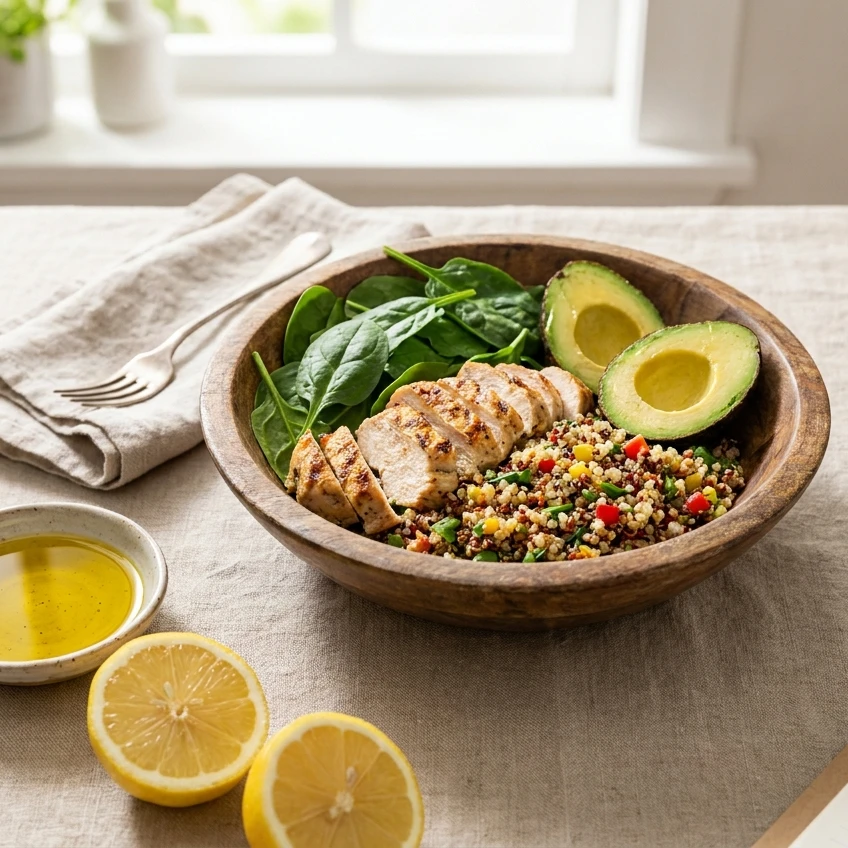
- Lunch — ~35 g protein. A Mediterranean quinoa bowl with avocado and grilled chicken or a tuna and chickpea salad. A 120 g chicken breast is ~36 g of protein on its own.
- Snack — ~10–15 g protein. A handful of edamame, a hard-boiled egg with a piece of fruit, or 30 g of cheese with an apple.
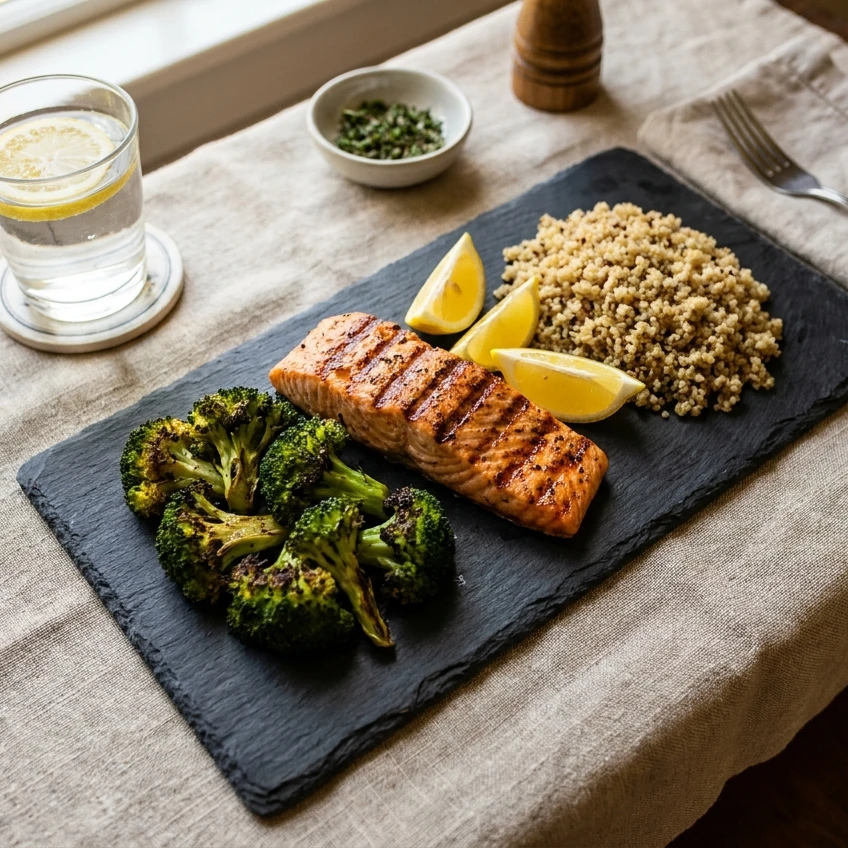
- Dinner — ~30 g protein. Salmon with lemon butter sauce and roasted vegetables, or grilled lemon herb chicken with quinoa. A 150 g salmon fillet delivers around 32 g of protein and most of your day's omega-3s.
Total: comfortably over 100 g of protein, with vegetables and whole grains filling the carb budget and the olive oil, salmon and avocado covering fats. No tracking app required after the first two weeks of calibration.
Common beginner mistakes (and what to do instead)
Setting protein too low because percentages told you to. A 25% protein split at 1,400 calories is only 87 g — well under what the evidence supports for someone in a deficit. Use grams per kilogram of bodyweight as your anchor, not percentages.
Cutting fat to "save calories." Fat is the easiest macro to underestimate because it's hidden in dressings, oils and cooking, but cutting it below 20% of calories tends to backfire. Hunger goes up; you blow the deficit by Friday.
Ignoring fibre. Fibre isn't technically a macro, but it's the difference between a calorie target you can stick to and one you can't. The NHS recommends 30 g of fibre per day, which most adults miss by about 10 g. Prioritise vegetables, beans, oats and whole grains.
Tracking forever. The point of tracking is calibration — two to four weeks is usually enough. After that, hand-portion estimates (palm of protein, thumb of fat, fist of carbs, two fists of vegetables) are accurate enough for most people.
Forgetting context. If you're pregnant, breastfeeding, managing diabetes or a thyroid condition, recovering from an eating disorder, or on regular medication, set your targets with a GP or registered dietitian — not a formula on the internet.
A simpler way to get your numbers
Doing the maths once is useful — it builds the intuition. Doing it every time you change weight, change training or rotate meals is the part that burns most people out. That's what the free NutriGuide quiz is for: 60 seconds in, you have your calorie target, your protein/fat/carb numbers, and a meal plan that hits them using foods you actually eat. No app download, no credit card, no calculator open at the dinner table.
This article is general nutrition information, not medical advice. If you are pregnant or breastfeeding, immunocompromised, recovering from surgery, taking regular medication, managing diabetes, a thyroid condition, kidney disease, IBS or IBD, or have a history of disordered eating, please speak to a GP or a registered dietitian before changing your diet.