Desk Job Weight Loss Diet Plan for Sedentary Workers
Sit 8+ hours a day? Why your TDEE drops, how NEAT closes the gap, and a desk-job diet plan that doesn't rely on the gym.


Desk Job Weight Loss Diet Plan for Sedentary Workers
You moved to remote work three years ago. The commute disappeared, the kitchen got closer, the "lunchtime walk" turned into a sandwich at the keyboard. You're not eating more — you're sure of that — but the trousers are tighter, the scale is up four kilos, and going to the gym twice a week doesn't seem to do anything.
Here's the part most blog posts skip. The single biggest difference between someone who maintains a healthy weight while desk-working and someone who slowly gains is not their gym attendance. It's everything else they do during the other 15 waking hours — walking to the printer, standing during calls, fetching water, fidgeting. The technical name is non-exercise activity thermogenesis (NEAT), and for an office worker it's worth more calories per week than three gym sessions on top of a still-sedentary day.
This is a guide to the lever you can actually move: the gap between your "sedentary" maintenance and your "lightly active" one. We'll show the math, then a meal pattern that fits the lower number without leaving you starving by 4 pm.
Why your maintenance calories quietly dropped
When a calorie calculator asks for your activity level, "sedentary" and "lightly active" look like two boxes on a form. They aren't. They're two different daily lives.
For a 35-year-old woman, 168 cm, 75 kg:
- Sedentary maintenance ≈ 1,820 kcal/day
- Lightly active maintenance ≈ 2,090 kcal/day
That 270 kcal/day gap is roughly the calories in a flat white plus a banana. Over a year, the same eating pattern lands her either at maintenance or at a slow 12 kg gain — and nothing about her food has changed. The lever is the activity column on the calculator.
For a 42-year-old man, 180 cm, 90 kg, the gap is closer to 320 kcal/day — about a chicken sandwich.
This is why "I'm not eating more" can be honestly true while the scale still climbs. You're not eating more; you're moving less than the calculator assumes when it sets your maintenance. The 2002 review of NEAT by Mayo Clinic researcher James Levine found that the energy spent on routine movement varies between people by up to 2,000 kcal per day — a range no gym schedule can match through workouts alone (Levine, 2002, Best Practice & Research Clinical Endocrinology & Metabolism).
Run the numbers on yourself. Calculate your real desk-job TDEE in 60 seconds — set activity to "sedentary" first, then re-run it as "lightly active" and look at the gap. That's the budget you get back when you rebuild daily movement.
The NEAT math, in numbers you can use
Rough numbers for an adult around 70 kg, walking at a normal pace:
| Add this | Roughly burns |
|---|---|
| 1,000 extra steps | 35–50 kcal |
| 4,000 extra steps (≈40 minutes split through the day) | 150–200 kcal |
| Standing instead of sitting for 3 hours | 30–60 kcal |
| Five "kettle break" laps around the house (5 min each) | 80–120 kcal |
Lighter people burn slightly less per step; heavier people burn more. Hills, stairs and a brisk pace bump the numbers. None of this needs a gym, a change of clothes, or a shower.
Two hundred extra kilocalories a day is 1,400 a week. That's the difference between losing 0.5 kg a month and staying flat — paid for in 35 minutes of walking spread across the day, not one all-or-nothing workout.
The UK Chief Medical Officers' 2019 guidelines make the same point in plain language: adults should "minimise the amount of time spent being sedentary, and when physically possible break up long periods of inactivity with at least light physical activity" (UK CMO physical activity guidelines, 2019). The WHO global guidelines echo this — at least 150 minutes of moderate activity per week, plus reduced sitting time as an independent recommendation (WHO physical activity fact sheet).
Translation: the formal exercise target and the "stop sitting so much" target are separate. Hitting one doesn't substitute for the other.
How to claw back NEAT in a remote-work day
You're not going to recreate a 30-minute commute and four floors of office stairs by accident. It has to be deliberate. Things that work, in rough order of ROI:
- A walking meeting once a day. Take any call that doesn't need a screen on a phone, walking. 25 minutes, 2,500–3,000 steps, no calendar disruption.
- One "lap" between every meeting. Stand up, walk to the kitchen, fill the water, walk back. 60–90 seconds, ~150 steps, repeated 8 times = 1,200 free steps.
- Standing for 2 hours of the workday, ideally split into 30-minute chunks. A standing desk converter or a stack of books on a regular desk both work.
- A 20-minute post-lunch walk. This one earns extra credit: a short walk after eating blunts the post-meal blood-sugar spike, which is its own metabolic win.
- A morning walk before the laptop opens. 15–20 minutes, even slow. You're banking steps before the day eats them.
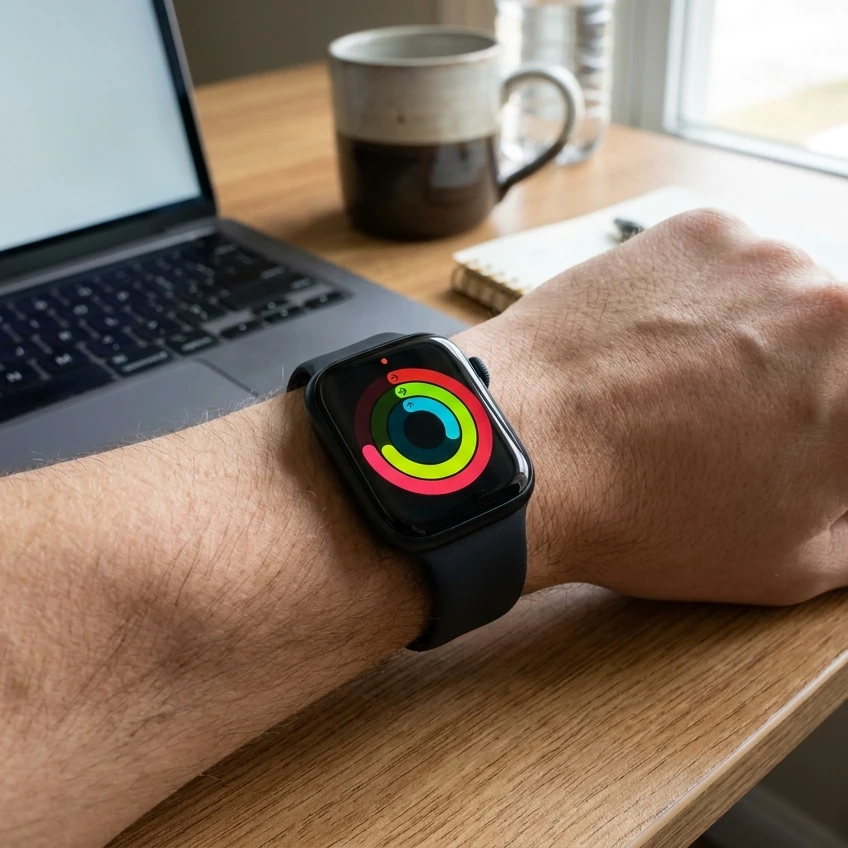
If you wear a fitness tracker, audit a normal week before you change anything. If your daily average is 3,200 steps, set a target of 4,200 next week — not 10,000. Stepping up by 1,000 steps a week reaches a sustainable 7,000–8,000 inside two months without the "ambitious for a week, exhausted, quit" cycle. If you want a deeper dive into using your tracker data to actually drive fat loss instead of decorating your wrist, see how to turn Apple Watch activity data into real weight loss.
The diet half: build meals that fit a smaller calorie budget
Here's the ugly truth about sedentary maintenance numbers: they're low. A small-framed woman with a desk job might be looking at a 1,500-kcal target to lose weight at 0.4 kg/week. That's not a lot of food. The two levers that make a low number bearable are protein and fibre — both keep you full longer per calorie than fat or refined carbs.
Practical targets for a desk worker losing weight:
- Protein: 1.6–2.0 g per kg of bodyweight per day. For a 75 kg adult, that's 120–150 g — usually 30 g per meal plus a snack. The exact number for your bodyweight comes out of the protein calculator. If you're new to building meals around protein, the high-protein approach to weight loss walks through it without the supplement-bro framing.
- Fibre: at least 25–30 g per day, mostly from vegetables, beans, oats, and fruit.
- Plate shape at lunch: half the plate non-starchy vegetables, a palm-sized protein, a fist-sized portion of starch (rice, potato, bread). Not a rule — a default that survives a busy Tuesday.
Two recipes that travel well from desk to fridge to lunch box:
- Quinoa, avocado and tomato salad — batch-prep three portions on Sunday, keeps four days, ~25 g protein when you add a tin of chickpeas or a chicken breast.
- Herbal microwave lemon chicken — 8 minutes start to finish in an office microwave, 30 g of protein, 179 kcal. The sedentary-day cheat code when meal prep falls apart.
The hardest part isn't the cooking. It's the drift — the oat milk in the latte, the handful of biscuits at the meeting, the "I forgot I had cheese on the salad". When you're sitting still, those invisible calories close the deficit faster than any one meal.
Spot the invisible calories before the scale does. Use the NutriGuide food journal → — pattern-recognition logging built for desk workers, no streaks, no shame. Two weeks of honest data is usually all it takes to find the drift.
For readers in their 40s, the same trousers issue gets compounded by hormonal shifts. The over-40 meal-plan guide covers what's specific to that decade.
If you have a chronic condition, mobility limit, pregnancy, or have been advised by your GP to restrict activity, ignore the step targets in this article and follow their guidance. This is general lifestyle advice, not medical advice.
A sample sedentary day at 1,700 kcal
For illustration only — your number comes out of the calculator. Adjust portions to your own targets.
- Breakfast (~430 kcal, 32 g protein): two-egg vegetable omelette, one slice of seeded sourdough, a handful of berries, black coffee.
- Lunch (~520 kcal, 38 g protein): quinoa salad with chickpeas and grilled chicken, lemon-tahini dressing, side of cucumber.
- Snack (~180 kcal, 20 g protein): Greek yoghurt with a tablespoon of pumpkin seeds.
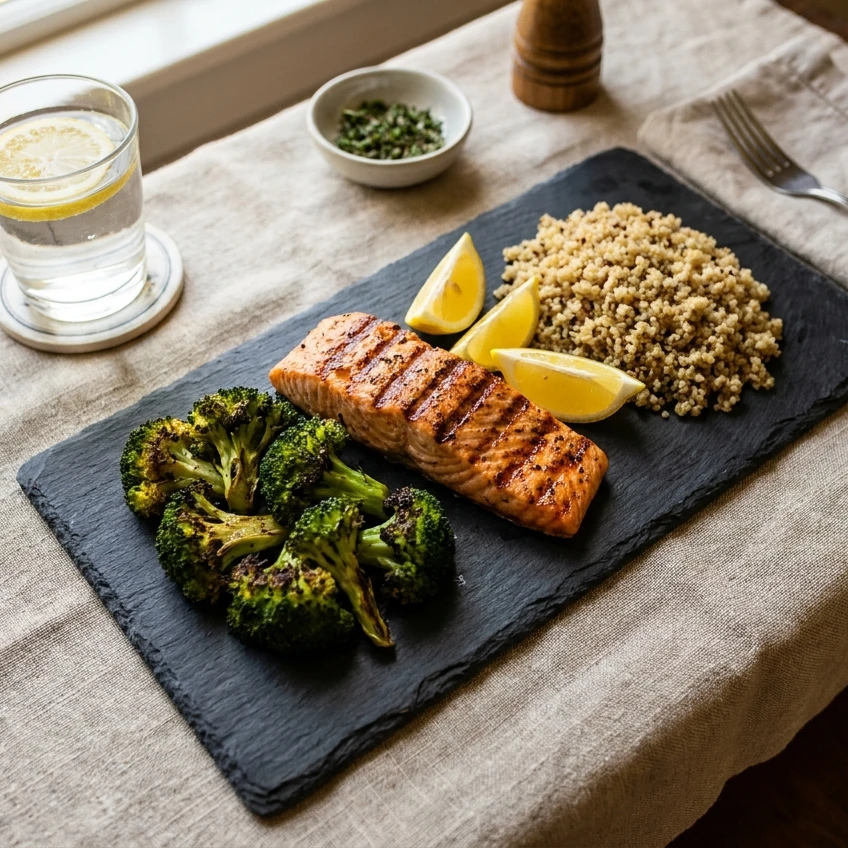
- Dinner (~520 kcal, 40 g protein): baked salmon, roasted vegetables, half a sweet potato, olive oil.
- Movement layered through the day: 7,500 steps split across a morning walk, walking call, post-lunch walk, evening loop.
The daily picture: a sedentary maintenance of ~1,950 kcal, plus ~250 NEAT kcal you brought back, gives you ~2,200 kcal of output against a 1,700 kcal intake. That's a ~500 kcal deficit per day — ~0.5 kg of fat loss per week, before you've stepped foot in a gym. Add two strength sessions a week if you want to protect muscle while you lose, but the desk-job problem doesn't get solved at the gym. It gets solved between 9 and 5.
Two adjacent things you'll wonder about
Meal timing matters less than total calories, but a compressed eating window can reduce the snacking pressure that desk proximity invites. The intermittent fasting guide for women covers what works.
Most readers don't need either. They need their real maintenance number, a believable deficit, and 6,000–8,000 daily steps they can actually walk.
Take the free NutriGuide quiz and let it build the meals around your real maintenance number, the way you actually eat, and the schedule you actually have. Two minutes, no app to install.
Reviewed by [name, RD] — placeholder pending sign-off.