Insulin Resistance Diet Plan — What to Eat to Reverse It
A food-positive eating plan for insulin resistance — what to put on the plate, what research suggests, and how to start.

Insulin Resistance Diet Plan: What to Eat to Reverse It Naturally
Reviewed by [Registered Dietitian — credential to be added at publish]
If your GP has just told you you're insulin resistant or pre-diabetic, the most useful thing you can do this week isn't a 30-day cleanse. It's a quiet, repeatable shift in what's on your plate three times a day. The evidence is unusually consistent on this: a low-glycaemic-index, fibre-forward eating pattern combined with modest weight loss can lower fasting insulin and, for many people, push HbA1c back into the normal range. The Diabetes Prevention Program trial in NEJM showed a 58% reduction in progression to type 2 diabetes from lifestyle changes alone — better than metformin in that study. So the plan below isn't restrictive. It's just what the research suggests works, translated into actual meals.
A note before we go further: this article is general information, not a personalised plan. If you've been diagnosed, your GP and a registered dietitian should set the targets that fit your bloodwork.
What insulin resistance actually is — in one paragraph
Insulin is the hormone that lets your cells absorb glucose from the bloodstream. When cells stop responding to it efficiently, your pancreas pumps out more insulin to compensate. Over years, that "more insulin" state drives weight gain (especially around the middle), elevated blood sugar, and eventually type 2 diabetes. The good news is the chain is mostly reversible at the diet-and-movement end. Diet works because it directly changes how much glucose hits your bloodstream after each meal — and how steeply.
Check your risk before you build a plan
Before changing anything, it's worth knowing where you're starting. Symptoms like persistent belly fat, sugar cravings, energy crashes after meals, dark patches on the neck or armpits, and fatigue an hour after eating are common signals. A short risk check turns those into a number you can act on.
If your score comes back medium or high, take it to your GP and ask for a fasting insulin test, HbA1c, and a fasting glucose panel. Those three numbers, together, tell you what you're working with.
The eating pattern, in plain English
Across the NHS Type 2 diabetes food guidance, American Diabetes Association recommendations, and recent peer-reviewed work, four things show up over and over:
- Half the plate is non-starchy vegetables. Leafy greens, broccoli, peppers, courgette, asparagus, cabbage, salad. They're low-GI, high-fibre, and physically fill you up before the carbs do.
- A palm of protein at every meal. Roughly 25–35g per meal — eggs, fish, chicken, tofu, Greek yoghurt, lentils. Protein blunts the post-meal glucose spike and keeps you full for four to five hours.
- Carbs that come with their fibre. Whole oats, quinoa, lentils, chickpeas, beans, sweet potato, berries, pears with the skin. The fibre slows digestion and flattens the glucose curve.
- Fat from real food, not factory food. Olive oil, avocado, nuts, seeds, oily fish. These don't move blood sugar much and improve insulin sensitivity in their own right.
What the plan deliberately does not include: a list of "forbidden" foods. Restriction triggers rebound. The reframe is additive — what can you put on the plate that helps you stay full longer? Most people find that when half the plate is vegetables and a quarter is protein, the remaining quarter sorts itself out.
A 2025 systematic review and meta-analysis in Frontiers in Nutrition pooled six randomised trials in adults without diabetes and found that low-glycaemic-index diets reduced HOMA-IR — the standard insulin resistance score — significantly more than high-GI diets. The effect was modest but consistent. Translation: the GI of your carbs matters more than the gram count for most people in the prediabetic range.
A sample day on the plate
Numbers below are sized for a 70 kg adult — adjust portions to your own protein and calorie needs.
Breakfast (around 30g protein, low-GI) Two-egg spinach and tomato frittata with a slice of rye toast and half an avocado. Or Greek yoghurt with berries, chia seeds and a small handful of walnuts. Skip the orange juice — eat the orange.
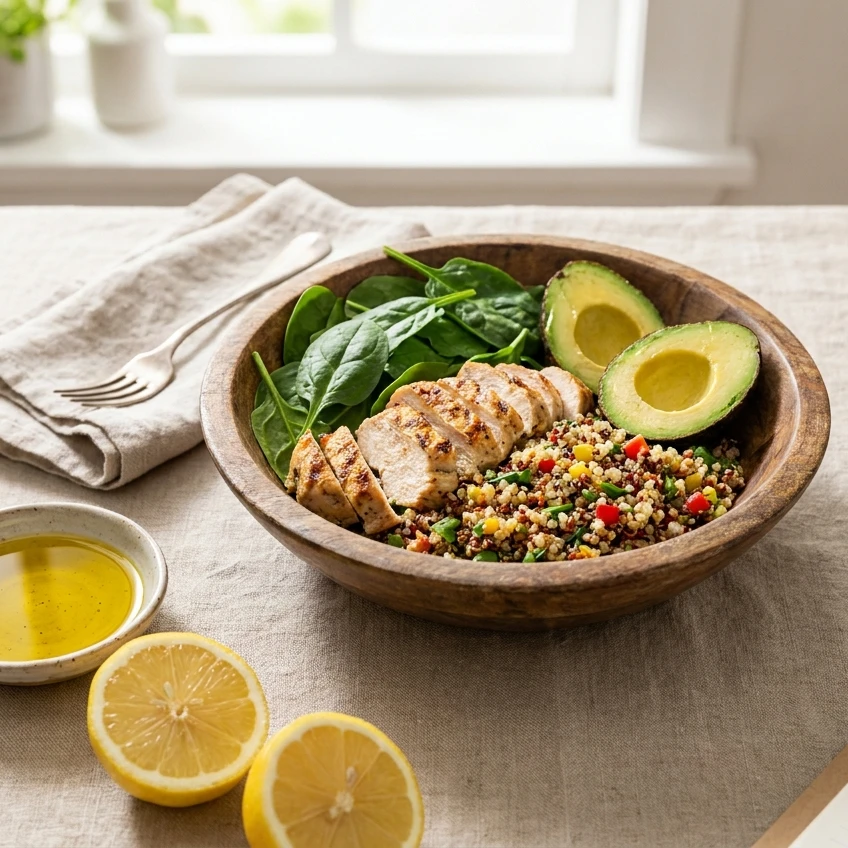
Lunch (vegetable-forward, ~25g protein) Big bowl of leafy greens, half a cup of cooked quinoa, grilled chicken or chickpeas, plenty of olive oil and lemon. A Mediterranean lentil and quinoa power bowl is a useful template — it nails the half-plate-vegetables, fibre-rich-low-GI-carbs structure in one bowl, with lentils blunting the glucose response further than rice or couscous would.
Snack (only if hungry) Apple with two tablespoons of almond butter. Or a hard-boiled egg with cherry tomatoes. Pair carbs with protein or fat — never eat carbs alone.
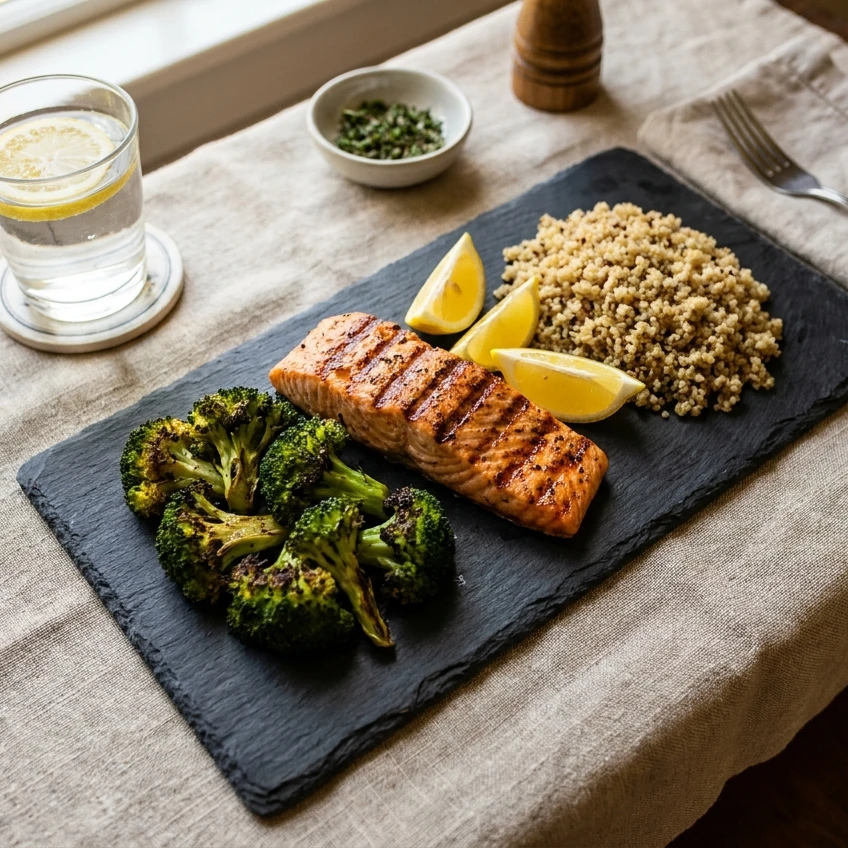
Dinner (~30g protein, slow carbs, big vegetable side) Grilled lemon garlic salmon with quinoa and broccoli is the template — fatty fish, a low-GI grain, and a vegetable side that takes up half the plate. Or a lentil and vegetable curry over half a cup of basmati. Red wine is fine in moderation; just keep it with the meal, not before it.
Drinks all day Water. Sparkling water. Tea. Coffee. Skip the sweetened lattes and the smoothies that hide 60g of sugar in fruit juice.
If macro split is something you want to think in, our beginner's guide to balancing macros for weight loss walks through how to get to roughly 30% protein, 35–40% carbs (mostly low-GI), and 25–30% fat without weighing your food.
Weight loss matters — but less than you'd think
The Mayo Clinic and ADA both put the threshold at modest: a 5–7% reduction in body weight is associated with substantial reductions in diabetes risk. For an 80 kg adult that's 4–5.5 kg. Not a transformation. A reachable target across three to six months. Combined with 150 minutes of moderate movement per week — walking counts — that's the lifestyle dose that's been studied.
If you'd rather not eyeball this, get a low-GI meal plan built for you that already weights the macros and recipes around insulin sensitivity, your weight goal, and what you actually like eating.
What the plan deliberately leaves out
- No "cheat days." That language frames eating as moral. It's not. Build a pattern you can repeat 80% of the time and stop scoring the other 20%.
- No fasted cardio or extreme fasting. Time-restricted eating in a 12-hour window is fine and may help; 18-hour fasts every day for a stressed 45-year-old usually backfire.
- No supplements as the headline. Berberine, inositol, and chromium have small effect sizes in the literature. Diet and walking have large ones. Get the base right first, then ask your GP about adjuncts.
If you also have PCOS, the picture is closely related but not identical — see our PCOS meal plan for weight loss for the overlap and the differences.
Putting it into next week
A practical first week:
- Audit, don't overhaul. For three days, photograph everything you eat. You'll spot the two or three blood-sugar landmines (usually breakfast, the 4 pm snack, and the drink) without needing an app.
- Swap, don't subtract. White toast and jam → eggs and avocado on rye. 11 am pastry → Greek yoghurt with berries. Fruit juice → whole fruit. Cereal → oats with seeds and berries.
- Walk after dinner. Twenty minutes after the largest meal of the day flattens the post-meal glucose curve more than most supplements.
- Retest at 90 days. Ask for a repeat HbA1c. The number is the only feedback that matters in the long run.
This is general guidance. If you're on metformin or any other medication that affects blood sugar, do not change your eating pattern dramatically without telling your prescriber — hypoglycaemia is rare on metformin alone but real on combination therapy.
Not sure where you sit on the risk scale? Check your insulin resistance risk in 60 seconds →
For women over 40, hormonal shifts make insulin sensitivity slightly more stubborn — our companion piece on a meal plan for women over 40 covers the perimenopause-specific adjustments.
This article is general information, not medical advice. If you've been diagnosed with insulin resistance or pre-diabetes, work with your GP or a registered dietitian on a plan tailored to your bloodwork.