High Protein Diet for Weight Loss — How Much You Need
How much protein you actually need for weight loss — the science behind 0.8, 1.2, and 1.6 g/kg, with a calculator and food targets.

How much protein you actually need for weight loss
Two numbers dominate the protein conversation, and they're 100% off from each other.
The WHO's official requirement for adults is 0.83 g of protein per kilogram of bodyweight per day. Gym culture says 1 g per pound — about 2.2 g/kg. For a 70 kg / 154 lb adult, that's the difference between 58 g and 154 g of protein a day. Same body, same goal, almost triple the food.
Both numbers are correct for what they were designed for. Neither is the right answer for someone trying to lose weight without losing muscle. The evidence-backed range for fat loss in a calorie deficit sits between them, around 1.2–1.6 g/kg/day — supported by the 2016 Phillips, Chevalier & Leidy review in Applied Physiology, Nutrition, and Metabolism, which specifically recommends "at least 1.2 to 1.6 g/(kg·day) of high-quality protein" for adults managing weight. For a 70 kg adult that's 84–112 g/day. For a 90 kg adult, 108–144 g/day.
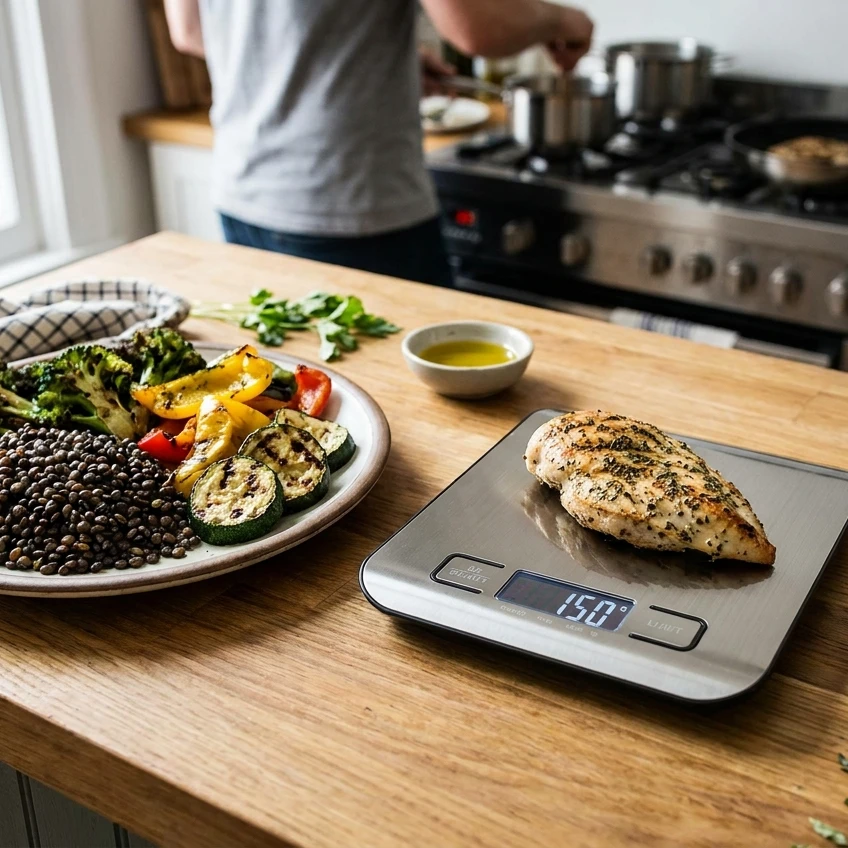
That's the answer most people came here for. The rest of this article explains why those numbers, and how to actually hit them without weighing chicken breasts on a kitchen scale every meal.
Why the WHO 0.83 g/kg figure is the floor, not the target
The 0.83 g/kg/day figure comes from the WHO/FAO/UNU 2007 expert consultation on protein and amino acid requirements — Technical Report Series 935. It's the population-level safe minimum to prevent nitrogen-balance deficiency in healthy sedentary adults. The floor, not the target.
Three things change once you're trying to lose fat:
- You're eating fewer calories than your body wants. A deficit signals "spare what's expensive to maintain" — and skeletal muscle is metabolically expensive. Without enough dietary protein, the body raids muscle for amino acids, lean mass drops alongside fat, and resting metabolic rate falls faster than it should.
- You want to feel full. Protein triggers stronger satiety responses than carbs or fat at the same calorie load — partly through GLP-1 and PYY release, partly through gastric distension. Higher-protein meals consistently produce less hunger and lower spontaneous intake at the next meal.
- You probably want to keep the muscle you've got. Even if you don't lift, walking, stairs, and carrying groceries all depend on lean tissue you'd rather not lose at 35, 45, or 55.
The WHO figure addresses none of those goals. It addresses "will this person develop a deficiency disease?"
Want the exact gram target for your bodyweight, age, and activity level? Calculate your daily protein target in 60 seconds — no signup required. The tool factors in your training load and adjusts for a calorie deficit, so you don't have to do the algebra yourself.
What the higher number (1.2–1.6 g/kg) is based on
The 1.2–1.6 g/kg/day range isn't a guess. It comes from a wave of trials over the past decade looking at what happens to body composition when adults eat more protein than the WHO floor while in a deficit.
The 2018 Morton et al. systematic review and meta-analysis in the British Journal of Sports Medicine pooled 49 randomised controlled trials covering 1,863 participants. The break-point in their data sat at 1.62 g/kg/day — beyond that, more protein produced no extra gains in lean mass during resistance training. That's the upper anchor. The lower anchor (1.2 g/kg) comes from the satiety and weight-management studies summarised in the Phillips/Chevalier/Leidy review above — the point where higher-protein diets start consistently outperforming standard-protein diets for fat loss outcomes.
What this looks like in practice for an adult in a calorie deficit:
| Bodyweight | WHO floor (0.83 g/kg) | Fat-loss range (1.2–1.6 g/kg) | Bodybuilder rule (2.2 g/kg) |
|---|---|---|---|
| 60 kg / 132 lb | 50 g | 72–96 g | 132 g |
| 70 kg / 154 lb | 58 g | 84–112 g | 154 g |
| 80 kg / 176 lb | 66 g | 96–128 g | 176 g |
| 90 kg / 198 lb | 75 g | 108–144 g | 198 g |
| 100 kg / 220 lb | 83 g | 120–160 g | 220 g |
A few honest caveats. If you carry more body fat, calculating your target against your lean bodyweight rather than total weight is reasonable — otherwise the gram targets balloon. Older adults (60+) seem to need slightly more, around 1.0–1.2 g/kg as a floor, to overcome the anabolic resistance that comes with age. Pick a number in the range and hit it consistently for 4–6 weeks before you tweak.
How national guidelines compare — and why they all undershoot for fat loss
Look at the official guidance in the four English-speaking markets we serve and a pattern emerges.
The NHS Eatwell Guide tells UK adults to "eat some beans, pulses, fish, eggs, meat and other protein foods" without specifying a gram target — it implicitly relies on the 0.75 g/kg UK Reference Nutrient Intake. The US Dietary Guidelines and the FDA-set Daily Value of 50 g for a 2,000-calorie diet land near the same RDA. Australia's CSIRO Total Wellbeing Diet is the outlier — its research-based protocol explicitly recommends higher-protein eating for weight loss, closer to the 1.2–1.6 g/kg range backed by the trials.
Why the gap? National bodies set public health minimums for a population that includes children, pregnant women, frail older adults, and people with kidney conditions. They're not setting goals for a 38-year-old trying to drop 10 kg without losing muscle. Different problems, different answers.
National guidance is the right floor for the average sedentary adult; if you've decided you're not the average sedentary adult, the trial-backed range above is where to aim.
What this looks like on a real plate
Numbers on paper don't help if you can't picture the food. A protein target of around 110 g/day — typical for a 75 kg adult in a deficit — splits cleanly across three meals and a snack:
- Breakfast (30 g): 3 eggs + 100 g of Greek yogurt, or stack two quinoa flour protein waffles (19 g protein each) for a no-cook morning that still hits the floor.
- Lunch (35 g): 150 g chicken breast on a salad, or 200 g cottage cheese with fruit, or 130 g tinned tuna with whole-grain crackers.
- Dinner (35 g): 150 g salmon, spinach and cheese stuffed chicken breast at 52 g protein for one main, or a spicy tofu and quinoa stir fry if you're plant-based (26 g protein).
- Snack (10–15 g): A handful of edamame, a small whey shake, or 30 g of jerky.
The pattern matters. Spreading protein across 3–4 meals at ~25–40 g each consistently outperforms back-loading 90 g into dinner. Muscle protein synthesis responds to a per-meal threshold (around 0.4 g/kg per meal in most studies), and meals below that threshold contribute less to lean-mass maintenance regardless of the daily total.
A few practical points the trial data backs up:
- Anchor every meal with a fist-sized portion of a dense protein source. Chicken, fish, lentils, tofu, eggs, Greek yogurt, cottage cheese, lean beef. Then build the rest of the plate around it.
- Treat protein powder as a tool, not a foundation. A scoop of whey or pea protein in a smoothie is fine — perfect for closing a 20 g gap on a busy day. A diet built on shakes is usually a diet you'll quit.
- If you're plant-based, combine sources. Lentils + rice, tofu + edamame, chickpeas + whole-grain bread. Plant proteins are often lower in one or two essential amino acids individually; combining sources solves this without requiring obsessive tracking.
- Fibre matters too. The satiety effect of a higher-protein diet is amplified when you also get 25–35 g of fibre a day. Lentils, beans, vegetables, oats. This is the part most "protein-only" advice misses.
For a deeper walkthrough of how protein fits with the other macros, see our beginner's guide to balancing macros for weight loss. And if your situation has wrinkles — perimenopause, a desk job, insulin resistance — the protein number doesn't change much, but the surrounding strategy does. Worth reading our pieces on meal planning for women over 40, losing weight when you sit all day, and the insulin resistance diet plan for context.
The honest bottom line
If you're trying to lose weight and keep the muscle you've got, eat 1.2–1.6 g of protein per kilogram of bodyweight per day. For most adults that lands somewhere between 80 g and 150 g, depending on size. Spread it across the day. Pair it with fibre. Hold the target steady for at least a month before deciding whether to adjust.
The WHO floor isn't wrong — it's just answering a different question. The 1 g/lb gym rule isn't dangerous — it's just usually unnecessary. The middle is where the trials live, and the middle is where most people get the satiety, lean-mass-retention, and "this is sustainable" benefits without forcing food they don't want.
Calculate your daily protein target in 60 seconds — the tool does the per-meal split, factors your activity, and gives you a number you can actually use today.
A note on safety: If you have kidney disease, liver disease, or have been told by your GP to limit protein, talk to a registered dietitian before raising your intake. The intake ranges in this article apply to healthy adults with normal kidney and liver function.
Reviewed by [name, RD] — placeholder pending sign-off.