Top 10 Supplements That Actually Support Healthy Weight Loss
Most weight-loss supplements don't work. Here are the ten with the most credible evidence, honest effect sizes and safety notes.


Most weight-loss supplements don't work. A handful do have small, real effects — usually by supporting satiety, protecting lean mass, or filling a genuine nutrient gap rather than by "burning fat." Here are the ten with the most credible evidence, graded honestly, with realistic effect sizes and who shouldn't take them.
Lifestyle is roughly 95% of the lever. Supplements, even the good ones, are a 1–5% nudge on top of food, sleep, training and adherence.
How we graded each supplement
Three categories, in order of evidence strength:
- Direct effect — moves energy balance, body composition or appetite in randomised trials.
- Adherence support — helps you stick to your plan (satiety, training recovery, energy).
- Adequacy — only helps if you're deficient or under-consuming from food.
Anything that didn't fit at least one of these honestly was cut. That's why garcinia cambogia, raspberry ketones, CLA, L-carnitine, apple cider vinegar pills and chromium aren't here — the evidence isn't there, and a few are actively risky. The LiverTox database catalogues over 200 cases of liver injury linked to garcinia cambogia, and the FDA forced the 2009 Hydroxycut recall after 23 reports of liver damage. We cover those traps in our 10 weight-loss supplement myths debunked with real research.
1. Protein powder (whey or plant)
Category: Direct + adherence. Strongest evidence on this list.
Protein has the highest thermic effect of any macronutrient (20–30% of its calories burned digesting it) and is the single best predictor of lean-mass retention in a calorie deficit. The 2018 BJSM meta-analysis by Morton and colleagues found that ~35 g/day of supplemental protein increased fat-free mass and strength gains during resistance training, on top of a baseline already supplying ~1.4 g/kg. A scoop of whey or pea protein typically gives 20–25 g for 100–120 kcal — a denser satiety return than almost any whole food at the same calorie cost. We cover the maths in our beginner's guide to balancing macros.
Realistic effect: large — but only if you were undershooting protein. Aim for 1.4–1.6 g per kg of bodyweight per day.
Skip if: you have advanced kidney disease (ask your GP). Lactose intolerant? Switch from whey to pea or soy.
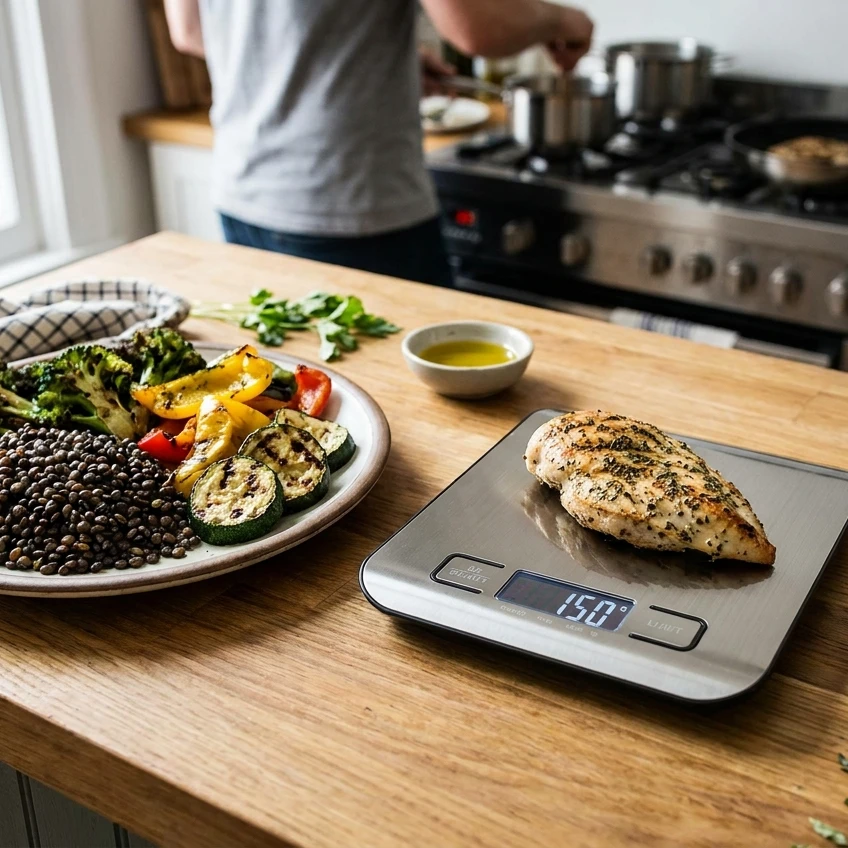
If hitting protein from food sounds easier, our chicken-and-spinach breakfast scramble and grilled lemon-herb chicken get most adults two-thirds of the way there in two meals. Not sure what your daily protein and calorie target should actually be? The free 60-second NutriGuide quiz calculates both from your body and activity, then builds a meal plan around foods you already like.
2. Caffeine
Category: Direct, small.
The most studied legitimate thermogenic. The classic Dulloo American Journal of Clinical Nutrition study found 100 mg of caffeine raised resting metabolic rate by 3–4% over 150 minutes; 100 mg every two hours produced an 8–11% bump. A 2019 dose-response meta-analysis (Tabrizi et al., Critical Reviews in Food Science and Nutrition) found pooled reductions in weight, BMI and body fat. Effects shrink with daily use — the cleanest payoff is before training (around 3 mg/kg, 30 minutes prior), where it also helps performance.
Realistic effect: ~80–150 extra kcal/day in non-habitual users; less in regulars.
Skip if: you have an arrhythmia, anxiety disorder, untreated high blood pressure, are pregnant (limit ~200 mg/day per NHS guidance), or stop sleeping after an afternoon coffee. Avoid stimulant-heavy "thermogenic blends" — they layer high-dose caffeine onto synephrine or yohimbine, with a real cardiovascular risk profile. More in our piece on whether supplements actually boost metabolism.
3. Glucomannan
Category: Adherence (satiety), small and contested.
Glucomannan is a soluble fibre from konjac root that absorbs water and expands in the stomach. It's the most commonly cited "natural appetite suppressant" — but the evidence is weaker than the marketing. A 2014 Onakpoya, Posadzki and Ernst meta-analysis pooled 8 RCTs and found a non-significant −0.22 kg versus placebo. Some individual trials are positive; the pooled estimate is essentially null. Where it can help: 1 g with 250 ml of water 15–30 minutes before meals, as a fullness tool if you're low on fibre.
Realistic effect: small at best on weight; modestly useful for hunger management.
Skip if: you have swallowing difficulties or a history of bowel obstruction. Always swallow with a full glass of water — taken dry, glucomannan has caused real choking and oesophageal-obstruction cases.
We compare glucomannan against other satiety tools in the best natural appetite suppressants and how to use them.
4. Fibre supplements (psyllium husk, inulin)
Category: Adequacy + adherence.
The average UK adult eats around 19 g of fibre a day; the British Nutrition Foundation recommends 30 g. Soluble fibre slows gastric emptying, blunts post-meal blood-sugar swings and feeds the gut microbiome. Psyllium husk has the cleanest RCT evidence for modestly improving satiety and reducing total intake.
Realistic effect: small on weight; meaningful on adherence and gut health if you were under-consuming.
Skip if: you have a gastrointestinal stricture, or separate from medications by 2 hours (fibre can slow drug absorption).
5. Creatine monohydrate
Category: Adherence (training support).
The most-studied supplement in sports nutrition, full stop. Creatine doesn't burn fat — it lets you train harder, which is what drives lean-mass gains and metabolic-rate preservation in a deficit. Recent meta-analyses combining creatine with resistance training show roughly +1.1 kg of lean body mass versus training alone. Protocol: 3–5 g/day of monohydrate, every day, no loading needed. The 1–2 kg of initial scale gain is intramuscular water, not fat — don't panic.
Realistic effect: small but reliable lean-mass advantage, especially for women and older adults defending muscle in a deficit.
Skip if: you have advanced kidney disease (otherwise long-term safety in healthy adults is well established).
6. Vitamin D3
Category: Adequacy.
Vitamin D doesn't directly cause weight loss — meta-analyses in obesity find at best small, inconsistent effects on weight and BMI. What it does fix is the high prevalence of deficiency, which shows up as low energy, poor mood and impaired muscle function — three things that quietly sabotage adherence. The NHS recommends 10 µg (400 IU) per day for all UK adults from October to March, and year-round for those with little sun exposure or darker skin. Get a blood test before going above that — cholecalciferol is fat-soluble and stores up.
Realistic effect: none directly on weight; meaningful on energy, mood and adherence if you were low.
Skip if: you have hypercalcaemia, sarcoidosis, or take thiazide diuretics without GP guidance.
7. Omega-3 (EPA/DHA fish oil or algae oil)
Category: Adequacy + small direct.
Omega-3 supplementation produces modest improvements in body composition in some trials — small reductions in fat mass and small improvements in lean mass, likely via lower inflammation and better insulin sensitivity rather than direct energy expenditure. Aim for 1–2 g/day of combined EPA + DHA, ideally from food (oily fish twice a week) or a third-party tested supplement (IFOS-certified). Algae-derived oils give vegans a real alternative.
Realistic effect: small.
Skip if: you take warfarin or other anticoagulants without GP supervision (omega-3 mildly thins blood at high doses). Salmon with lemon-butter sauce twice a week beats a capsule on every metric, including absorption.
8. Green tea extract / EGCG
Category: Direct, very small.
Green tea catechins, particularly EGCG, raise thermogenesis and fat oxidation by small amounts. The 2009 Hursel meta-analysis in the International Journal of Obesity found catechin–caffeine mixtures produced a small effect on weight and weight maintenance — typically under 100 kcal/day, with tolerance reducing benefit over time. The catch: high-dose EGCG (>800 mg/day from extracts) has been linked to liver injury in case reports, flagged by EFSA in 2018. Brewed green tea (3–4 cups) is fine; concentrated extract is where the risk lives.
Realistic effect: very small, often within measurement noise.
Skip if: you have liver disease or take hepatotoxic medications. Stick to brewed tea.
9. Magnesium
Category: Adequacy.
Magnesium is involved in over 300 enzymatic reactions, including glucose metabolism and muscle function. UK National Diet and Nutrition Survey data shows ~10–15% of adults consume below the lower reference nutrient intake. Low magnesium shows up as poor sleep, muscle cramps and irritability — all of which undermine training and food choices. Glycinate or citrate at 200–300 mg/day is well tolerated; oxide is cheap but poorly absorbed and laxative.
Realistic effect: none directly on weight; meaningful on sleep and recovery if you were low.
Skip if: you have kidney disease.
10. Probiotics — specific strains only
Category: Adherence + small direct, strain-specific.
The probiotic aisle is a minefield: most strains have no weight-related evidence. The exception with the most data is Lactobacillus gasseri SBT2055, where a 12-week randomised trial in the European Journal of Clinical Nutrition showed a 4.6% reduction in visceral fat versus placebo. The effect is small and strain-specific — generic blends don't have equivalent data. A live-fermented food approach (kefir, kimchi, live yoghurt) covers most of the same ground without supplement-aisle prices. Our blueberry yogurt parfait is a workable starting point.
Realistic effect: small and strain-specific.
Skip if: you're severely immunocompromised (live cultures can rarely cause infection in immunosuppressed patients).
For the deeper picture on the gut–weight link, see the impact of gut health on weight loss.
Build the plan first, layer supplements second
Notice what isn't on this list: anything promising a fast result on its own. The supplements with real evidence work because they support a calorie deficit, a protein target and consistent training — not in spite of them. Spending £40 a month on stacks while under-eating protein and over-snacking is the most common mistake in this category.
If you'd like the calorie target, protein number and a week of meals already calculated for your body and habits, the free 60-second NutriGuide quiz does that part. No app, no credit card. Decide on supplements after the plan exists.
This article is general nutrition information, not medical advice. Supplements interact with medications including warfarin, SSRIs, metformin, blood-pressure drugs, thyroid medication and lithium. If you are pregnant or breastfeeding, recovering from an eating disorder, taking any prescription medication, or living with kidney, liver or cardiovascular disease, please speak to a GP or registered dietitian before starting any supplement. "Natural" does not mean safe.