Meal Plan for Women Over 40 — Weight Loss That Works
A food-positive meal plan for women 40+ — built around protein, fibre and the perimenopausal metabolic shift.


Meal Plan for Women Over 40 — Weight Loss That Actually Works
You used to lose five pounds by drinking more water and eating a bit less bread. Now you've cut out wine, swapped lunch for a salad, and the scale hasn't moved in six weeks. You aren't doing anything wrong. The rules changed.
For most women between 40 and 55, two things happen at the same time. Lean muscle starts declining — Mayo Clinic puts the onset around age 30, with the rate accelerating through the menopausal transition — and falling oestrogen begins redistributing body fat toward the abdomen. A 2012 International Menopause Society review of midlife weight gain confirmed that menopause "is associated with an increase in total body fat and an increase in abdominal fat," even when total weight stays flat. The honest version: your maintenance calories are 100–200 lower than they were a decade ago, your insulin sensitivity has dipped, and your body is far more interested in storing energy as belly fat than it used to be. The fix isn't another round of restriction. It's a meal pattern designed for the body you actually have now.
What changes after 40 — and why old diets stop working
The phrase "metabolism slows after 40" hides the actual numbers. Resting metabolic rate drops by roughly 1–2% per decade from your 30s onward, mostly because lean muscle mass declines. By 45, a woman who hasn't lifted heavy things in years has often lost 3–5 kg of muscle compared with her 30s — and muscle is the tissue that burns calories at rest.
Stack that on top of the perimenopausal hormonal shift, which the NHS describes as starting "months or years before your periods stop", and you get a body that is more insulin-resistant, more prone to abdominal fat storage, and slower to recover from sleep loss or skipped meals. Crash diets make it worse: a 1,200-calorie cut hits an already-shrinking muscle base, accelerating the loss.
What works instead is a higher-protein, higher-fibre, moderate-deficit pattern that protects lean mass. The 800-calorie smoothie cleanse your sister did at 28 is the wrong tool for the job at 47.
See your metabolic age in 60 seconds — run the metabolic age calculator before you set a calorie target. It pulls your real basal rate from your height, weight, age and activity instead of guessing.
The eating framework: protein floor, fibre wall, satisfying plate
Three rules, not thirty:
1. Hit a protein floor at every meal. The WHO/FAO/UNU baseline of 0.83 g of protein per kg of bodyweight per day is enough for a sedentary 25-year-old man. For women in midlife trying to lose fat without losing muscle, research on protein needs in older adults has consistently pointed higher — 1.0–1.2 g per kg, spread across the day. For a 70 kg (11 st / 154 lb) woman, that's about 25–30 g per meal. Concretely: two eggs and Greek yoghurt at breakfast, a chicken-and-quinoa salad at lunch, salmon with lentils at dinner.
2. Build a fibre wall. UK and US dietary guidance both land around 25–30 g of fibre a day, and most women over 40 eat barely half that. Fibre slows glucose response, feeds gut microbes that influence weight regulation, and keeps you full enough to skip the 4 pm biscuit. Vegetables at lunch and dinner, beans or lentils a few times a week, berries on the yoghurt.
3. Make the plate satisfying enough to repeat tomorrow. A meal you don't enjoy is a meal you'll abandon by week three. Olive oil, herbs, a generous handful of cheese where it belongs, dark chocolate after dinner — none of these are off-limits. The goal isn't to eat like a 22-year-old fitness influencer. It's to build a pattern you can run for years.
If you're not sure what your actual maintenance number is, calculate your maintenance calories and subtract 300–500 for a sustainable deficit. Anything bigger and you'll feel it in your sleep, your hair and your training.
A sample day at 1,650 calories
This is a real day for a 5'5", 70 kg woman aiming for a moderate deficit. Adjust portions up or down based on your own numbers.
Breakfast (around 450 cal, 32 g protein) Two eggs scrambled with spinach and feta, half an avocado, a slice of seeded sourdough. Black coffee or tea. If mornings are rushed, a spinach and chicken breakfast frittata batched on Sunday gives you four breakfasts in one go at 27 g of protein each — exactly the floor we just defined.
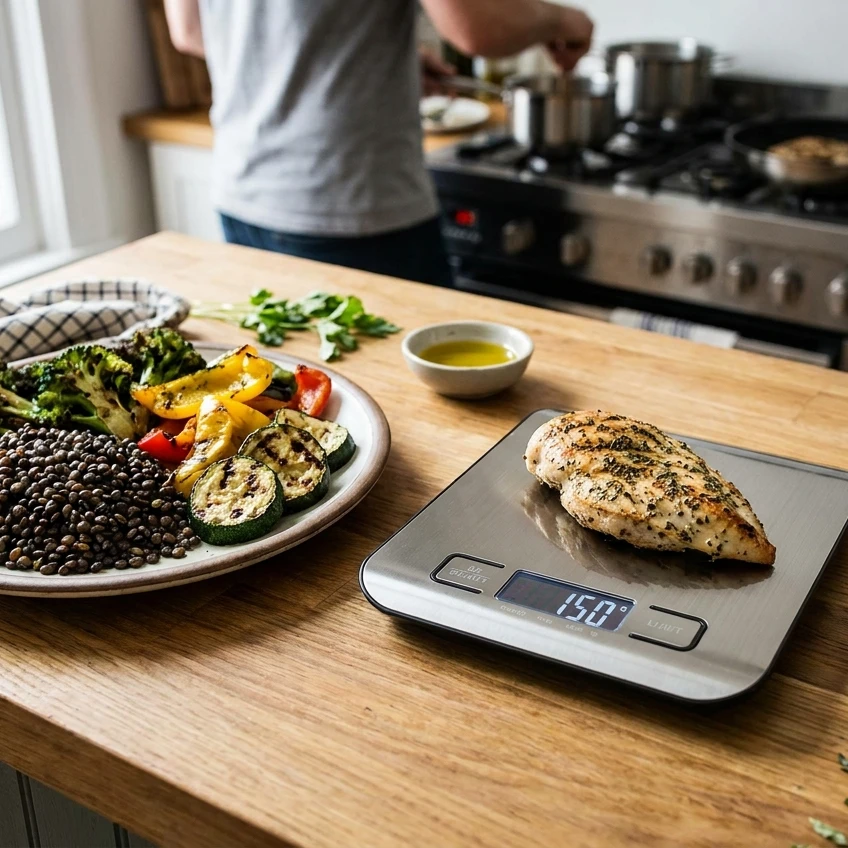
Lunch (around 500 cal, 35 g protein) A chicken and avocado salad bulked out to 150 g of chicken, lemon-tahini dressing, plenty of leaves. Big enough to keep you full until dinner without a 3 pm snack hunt — and the avocado fat plus protein density is what closes the gap on a perimenopausal afternoon.
Snack (around 200 cal, 15 g protein) A small Greek yoghurt with berries and a tablespoon of pumpkin seeds. Or a hard-boiled egg and an apple if you're between meetings.
Dinner (around 500 cal, 35 g protein) Grilled salmon with lemon herb quinoa ticks every box on the framework — 39 g of protein, Mediterranean fat profile, fibre-rich quinoa, room for a generous side of roasted vegetables. Or chicken thighs with Brussels sprouts and lentils. Olive oil and lemon, herbs, salt.
A glass of red wine or a square of dark chocolate fits inside this. So does a Saturday lunch out. The pattern is what does the work, not the specific Tuesday.
Movement that protects the framework
Diet alone won't undo midlife muscle loss. The Mayo Clinic's guidance for menopausal weight management is blunt about this: "as you gain muscle, your body burns calories better," and resistance training is what builds it. Two strength sessions a week — body weight, dumbbells, kettlebells, machines, anything — moves the needle more than another hour of cardio.
Walking still matters. So does sleep, which gets harder in perimenopause and quietly drives appetite hormones in the wrong direction. None of this is glamorous. All of it is what works.
Where to go deeper
A few specific patterns worth knowing about:
- If you have signs of blood sugar issues — energy crashes, fasting glucose creeping up, a PCOS history — a lower-carb framing helps. Start with our insulin resistance diet plan for the food list and meal structure.
- If you're navigating PCOS alongside perimenopause, the overlap is real. The PCOS meal plan for weight loss covers the specifics.
- Curious about fasting? Standard 16:8 advice was built on male physiology. The women-specific fasting guide explains why and what to try instead.
Hormonal changes after 40 vary widely. This article is general information — talk to your GP or a registered dietitian for guidance tailored to your bloodwork.
The version of weight loss that worked at 25 punished you into compliance. The version that works at 45 feeds you well, lifts heavy things, and waits. It's slower. It's also the one that holds.
Build a meal plan around the body you have now. Take the free Nutriguide quiz → — 2 minutes, no app to install, and the plan factors in age, activity and what you actually like eating.